
Compression Stockings for Leg Ulcers: What the Evidence Says
By Sean Tang
Last reviewed: September 5, 2026
If you or someone you care for is dealing with a venous leg ulcer — or trying to keep a healed one from coming back — you’ve almost certainly been told compression is essential. But the advice usually stops there. What compression level actually heals an ulcer? Stockings or bandages? And can compression keep it from returning once the wound closes?
Here’s the short answer: compression therapy is the standard of care for venous leg ulcers, with most protocols targeting 30–40 mmHg at the ankle for patients with healthy arteries. Before any compression is started, an ABPI (ankle-brachial pressure index) check confirms it’s safe. And after healing, continued compression may cut the risk of recurrence roughly in half — but only if you can wear it consistently.
This guide walks through the mechanism, the evidence, the safety screening, and the practical questions of level, style, and fit for ulcer care.
What Is a Venous Leg Ulcer, and Why Does Compression Help Heal It?
A venous leg ulcer (VLU) is an open wound on the lower leg — usually near the ankle — caused by chronic venous hypertension. Here’s the chain of events: the one-way valves in the leg veins fail, blood pools in the lower leg under abnormally high pressure, fluid and blood cells leak into the tissue, the skin becomes damaged and discolored, and eventually it breaks down into a wound that resists healing.
Compression is the cornerstone of treatment because it attacks that mechanism directly. A graduated compression garment — firmest at the ankle, decreasing up the leg — applies external counter-pressure to the tissues, which:
- Reduces the diameter of the superficial and deep veins, improving the efficiency of the calf-muscle pump and venous return
- Lowers venous pressure at the ankle during standing and walking
- Limits capillary fluid leakage, reducing edema that starves skin of oxygen
- Supports the lymphatic drainage that helps resolve chronic inflammation
The Society for Vascular Surgery / American Venous Forum / American Venous and Lymphatic Society clinical practice guidelines on venous leg ulcer management (O’Donnell et al., J Vasc Surg 2014) recommend compression therapy as the primary treatment modality, and Mosti and colleagues (J Vasc Surg Venous Lymphat Disord 2021) describe an ankle pressure target above 30–40 mmHg during muscle activity for effective ulcer treatment.
The key insight: compression doesn’t just protect the wound — it reverses the conditions that created it. That’s why it’s standard of care rather than optional support.
How Effective Is Compression Therapy for Venous Leg Ulcers?
The evidence base is substantial — and unusually consistent.
A systematic evidence review of compression therapy for venous leg ulcers (PMC4144247) reports that compression improves healing rates compared with no compression, and that higher-pressure, multilayer systems outperform single-layer bandaging. A broader evidence- and consensus-based algorithm for compression in prevention, treatment, and recurrence of VLUs (PMC4937809) similarly supports compression as first-line treatment at every stage.
The recurrence data deserve special attention, because recurrence is where ulcer care so often fails: roughly half of healed venous leg ulcers reopen within a year without ongoing management. The same evidence reviews report that continued compression after healing significantly reduces recurrence — in several analyses, approximately halving it compared with no post-healing compression.
A few honest caveats:
- Compression works best alongside the full wound-care program: leg elevation, exercise, wound dressing care, and treatment of the underlying venous reflux when indicated
- Adherence is the biggest practical obstacle — compression only works on the days you wear it
- Healing timelines vary widely; small ulcers may close in weeks, while long-standing or large ulcers can take months
Set expectations with your wound-care team: compression is highly effective, but “effective” means measurably faster healing and fewer recurrences — not instant results.
Get Your ABPI Checked Before Compression
This section is the one most consumer guides skip, and it’s the most important.
ABPI (ankle-brachial pressure index, also abbreviated ABI) compares blood pressure at your ankle with blood pressure at your arm. It’s a simple, non-invasive test that tells your care team whether your arteries can safely tolerate compression. The consensus algorithm for compression in venous leg ulcers (PMC4937809) is explicit: ABPI-guided compression selection is the standard of care.
The general thresholds:
| ABPI result | What it means | Compression approach |
|---|---|---|
| Above 0.8 | Arterial supply adequate | Full compression (30–40 mmHg) appropriate |
| 0.5 – 0.8 | Mixed arterial-venous disease | Modified, light compression — typically ≤30 mmHg, clinician-directed |
| Below 0.5 | Significant arterial disease | Compression avoided or radically modified; vascular referral |
The middle band matters more than most people realize. Research on modified compression in mixed arterial-venous ulcers (PMC8613381) supports careful, reduced-pressure compression (often 20–30 mmHg with frequent monitoring) for ABPI between 0.5 and 0.8 — because the venous component still needs treatment, but full pressure could starve the leg of arterial blood.
The practical takeaway: never start compression for a leg ulcer without an ABPI result, and treat any recommendation that skips this step as incomplete advice. If your care team hasn’t ordered one, ask. It’s a ten-minute test that prevents serious harm.
Which Compression Level for Venous Leg Ulcers?
Once arterial status is confirmed adequate, compression level selection is fairly standardized for ulcer care:
30–40 mmHg (extra firm): The standard target for most venous leg ulcers. This is the level most evidence reviews and guidelines cite for active ulcer treatment and post-healing recurrence prevention. The Mosti 2021 review specifically notes that effective ulcer compression requires ankle pressures above 30–40 mmHg during muscle activity.
40–50 mmHg (heavy/Class 3): Occasionally used for severe, refractory edema or lymphedema components — strictly under specialist direction, with custom-measured or custom-made garments.
Below 30 mmHg: Appropriate only when ABPI is between 0.5 and 0.8 (modified compression) or for patients who genuinely cannot tolerate higher levels. Under-treatment is a real risk — a 15–20 mmHg garment may be comfortable but may not deliver the pressure needed to heal an ulcer.
Style: below-knee (knee-high) garments are the standard for venous leg ulcers, because the disease and wounds are concentrated at the ankle and lower calf. Knee-highs are also easier to don — a decisive factor when adherence determines outcomes.
Because ulcer care sits at 30–40 mmHg and above, this is unambiguously clinician-directed territory: the level, garment, and wear schedule should be set by your wound-care team. For background on how the levels differ generally, see our compression level guide and our 15–20 vs 20–30 mmHg comparison.
Stockings vs Multilayer Bandages During Active Ulcer Care
One of the most common points of confusion: if stockings are so effective, why do ulcer patients so often wear bandages?
The division of labor looks like this:
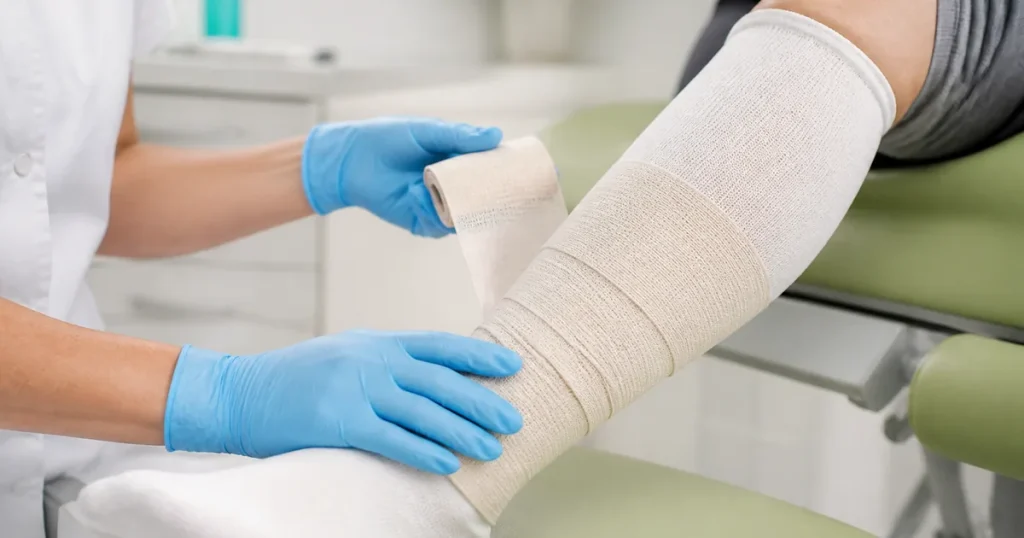
During active wound care — when the ulcer is open — clinicians typically use compression bandages, most often multilayer systems (two to four layers applied by a trained clinician). Reasons:
- Bandages accommodate wound dressings and exudate
- Layer tension can be adjusted limb-by-limb and visit-by-visit as edema changes
- The clinician controls application pressure directly
- Odd-shaped or heavily exudative wounds need dressing changes too frequent for a stocking
Once the ulcer has healed — stockings take over as maintenance therapy. This is where medical compression stockings shine: they’re more practical for daily self-management, more consistent in pressure, and far more acceptable to wear long-term than bandages.
The transition usually happens at the “healed” milestone: your wound-care team confirms closure, re-measures the leg, and prescribes a 30–40 mmHg below-knee stocking for ongoing wear. Some protocols continue a transition bandage for a short period first.
If your wound has healed and you’ve been discharged without a maintenance compression plan, ask about one — this handoff point is where the recurrence-prevention evidence says the biggest gains are, and it’s also where patients most often fall through the cracks.
Compression Stockings to Prevent Ulcer Recurrence
Preventing recurrence is the quiet, crucial second half of ulcer care — and the evidence supports long-term compression after healing.
The evidence reviews (PMC4144247, PMC4937809) report that patients who continue compression after their ulcer heals have roughly half the recurrence rate of those who don’t. Given that recurrence without protection approaches 50% within a year, this is arguably the highest-value use of compression in the entire ulcer journey.
What long-term maintenance typically looks like:
- 30–40 mmHg below-knee stockings, worn every day, during waking hours
- Put on in the morning before getting up or before swelling builds
- Daily skin care and moisturization, applied at night when the stocking is off
- Periodic re-checks with the wound-care or vein team, especially if the leg changes size
Adherence is the hard part. A 30–40 mmHg garment is genuinely difficult to don — especially for older patients, arthritic hands, or anyone managing obesity. This is where donning aids stop being a luxury:
- Rubber-dotted donning gloves improve grip dramatically
- Donning frames/butlers let you don a knee-high without bending deeply
- Silk or slippery donning sleeves reduce friction against the skin
If a stocking sits unworn in a drawer because it’s too hard to put on, the clinical evidence never gets a chance to work. Tell your care team if donning is your barrier — they can prescribe aids, adjust the garment style (open-toe, zipper with an inner liner), or refer to a lymphedema therapist for technique training. JOBST products, like other medical-grade garments, are available in open-toe and zipper-assisted styles that many ulcer patients find more manageable.
Measuring and Fit for Ulcer Care
Fit is more complicated in ulcer care than in almost any other compression scenario, because the limb changes.
Why measurement is tricky: an active ulcer leg is often heavily edematous. A stocking measured and fitted at peak swelling will be too large once the edema resolves — and an oversized compression garment under-compresses, quietly undoing the therapy. The consensus approach is to re-measure and refit as the leg reduces, which is one more reason ulcer compression belongs under clinical oversight rather than self-managed shopping.
How measurement works: compression garments are sized by ankle circumference, calf circumference, and length — taken in the morning when swelling is least. Match those numbers to the brand’s size chart; never size by shoe size or clothing size.
Practical fit points for ulcer patients:
- Measure the leg at the point in your edema cycle your clinician specifies — usually after maximal reduction has been achieved
- Re-measure every 3–6 months, or sooner if the stocking feels loose or the leg visibly changes
- Watch for a digging top band, toe crowding, or numbness — signs the fit needs adjustment
- Keep two pairs in rotation so one is always clean and dry
Our step-by-step fit guide covers the measuring process in detail, and our buyer’s guide explains how level, style, and size interact. If limb shape is irregular after long-standing ulcer disease, ask your team about made-to-measure garments — standard size charts assume a normally shaped leg.
Red Flags: When Compression Is Not Appropriate
Compression is powerful therapy, and powerful therapy has contraindications. Compression for leg ulcers should be avoided or used only with specialist direction when there is:
- Significant arterial disease — ABPI below 0.5, or symptoms of critical limb ischemia (rest pain, blue or black toes, non-healing toe wounds). Compression can dangerously reduce arterial inflow.
- Mixed arterial-venous disease (ABPI 0.5–0.8) — modified, reduced compression only, with vascular-team oversight and frequent reassessment (PMC8613381).
- Acute cellulitis or infection of the leg — compression is usually paused until the infection is treated.
- Uncontrolled heart failure — the fluid shift compression provokes can overload a failing heart.
- Acute DVT — compression during the acute clot phase is a decision for the treating team, not the patient.
During wear, treat these as stop-and-call signals:
- New numbness, tingling, or burning in the foot
- Toes turning pale, blue, cold, or increasingly painful
- A wound that worsens despite faithful compression
- Rapid new swelling above the garment
Ulcer care works best as a team sport: wound-care nurse, vascular specialist, and primary care provider all have a role. The compression garment is one instrument in that ensemble — an important one, but not a solo act.
Frequently Asked Questions
What compression level is best for venous leg ulcers?
For most patients with adequate arterial circulation (ABPI above 0.8), 30–40 mmHg at the ankle is the standard target for ulcer healing and recurrence prevention. Higher levels (40–50 mmHg) are occasionally used for severe cases under specialist care. If ABPI is 0.5–0.8, modified compression at 30 mmHg or below is used instead.
Do compression stockings heal leg ulcers on their own?
Compression is the foundation of ulcer treatment, but it works best as part of a complete program that typically includes wound dressings, leg elevation, exercise, and treatment of the underlying vein problem when indicated. Compression controls the cause — venous hypertension — while the wound itself closes.
Stockings or bandages for a leg ulcer?
While the ulcer is open, clinicians usually apply multilayer compression bandages, which accommodate dressings and can be adjusted as swelling changes. After healing, compression stockings take over as daily maintenance to prevent recurrence.
Can compression stockings stop a leg ulcer from coming back?
The evidence suggests yes, substantially. Continued compression after healing is associated with roughly half the recurrence rate compared with no compression — meaningful, since about half of healed ulcers reopen within a year without protection. Daily wear is what makes the difference.
Do I need a test before wearing compression for an ulcer?
Yes. An ABPI (ankle-brachial pressure index) test should be performed before compression begins, to rule out arterial disease that would make compression unsafe. It’s quick, non-invasive, and standard practice.
What if I can’t put a 30–40 mmHg stocking on by myself?
This is common and solvable. Ask about donning gloves and frames, open-toe or zipper-assisted garment styles, made-to-measure options, and referral to a therapist for donning technique training. A compression plan you can actually follow beats a stronger one you can’t.
The Bottom Line
Compression therapy is the single most important treatment for venous leg ulcers: it reverses the venous hypertension that causes them, accelerates healing while the wound is open, and — continued after healing — may cut recurrence roughly in half. The standard is 30–40 mmHg below-knee compression, but only after an ABPI check confirms your arteries can safely handle it, and always within a wound-care team’s plan.
If your ulcer has healed and you don’t have a maintenance compression prescription, ask for one — that’s the moment the recurrence evidence says matters most.
Ready to build your long-term compression routine? Shop compression stockings by condition, start with our step-by-step measuring guide, or learn how compression fits into broader vein care in our guide to compression stockings for varicose veins. For legs with a significant swelling component, see our overview of compression garments for lymphedema.
Keep Reading
- Compression Stockings for Varicose Veins: Which Level (mmHg) and Style Is Right for You?
- Shop Compression Stockings by Condition
- Compression Garments for Lymphedema
Disclaimer: This content is for educational purposes only and does not replace professional medical advice. Always consult a healthcare provider before starting compression therapy, especially at 20 mmHg or higher or if you have arterial disease, diabetes, or neuropathy. This content has not been reviewed by a licensed healthcare professional.
JOBST® is a trademark of Essity/BSN medical. JobstCompressionStocking.com is operated by Pro Therapy Supplies, an authorized retailer of JOBST products. We do not manufacture JOBST products.
Sources
- “Compression therapy for venous leg ulcers.” Evidence review (PMC4144247). — Healing rates and recurrence data for compression vs no compression.
- “Compression for primary prevention, treatment, and prevention of recurrence of venous leg ulcers: evidence- and consensus-based algorithm.” (PMC4937809). — ABPI-guided compression level selection.
- “Modified compression therapy in mixed arterial-venous leg ulcers.” (PMC8613381). — Reduced-pressure compression for ABPI 0.5–0.8.
- O’Donnell TF, et al. “Management of venous leg ulcers: clinical practice guidelines of the Society for Vascular Surgery and the American Venous Forum.” Journal of Vascular Surgery. 2014 (PubMed 24833130). — Compression as primary VLU treatment.
- NICE. “Compression products for treating venous leg ulcers: late-stage assessment.” HTG758. — UK guidance on compression product selection for venous leg ulcers.
- Mosti G, et al. “Theory and practice of compression therapy for treating and preventing venous ulcers.” J Vasc Surg Venous Lymphat Disord. 2021 (PubMed 33546903). — Ankle pressure target above 30–40 mmHg during muscle activity.