
Compression Garments for Lymphedema: How to Choose the Right Level, Style, and Fit
By Sean Tang
Published: September 4, 2026 | Last reviewed: September 4, 2026
If you’ve been diagnosed with lymphedema, you’ve probably heard that compression garments will be part of your life from now on. That can feel overwhelming — there are sleeves, stockings, gauntlets, gloves, wraps, flat-knit, circular-knit, and at least five different pressure levels. Here’s the short version: most people with lymphedema do best with 20–40 mmHg compression, chosen and fitted with a certified lymphedema therapist, and the right garment depends on where your swelling is, how much limb shape has changed, and whether you’re in an active treatment phase or long-term maintenance.
This guide walks you through every decision — compression level, knit type, garment style, day versus night options, and wraps — so you can walk into your fitting appointment informed and ask better questions.
One important note before we start: compression for lymphedema is not a self-select category the way travel socks or mild varicose-vein stockings are. Once you’re at 20 mmHg or above, the choice is a clinical one, made with a certified lymphedema therapist (CLT) or your physician.
What Is Lymphedema? Primary vs. Secondary (and Why It Changes Your Garment)
Lymphedema is a chronic condition in which protein-rich fluid accumulates in the tissues because the lymphatic system can’t drain it effectively. It most often affects an arm or a leg, and it is typically lifelong — but with the right management, most people keep it well controlled.
There are two broad types:
- Primary lymphedema results from a congenital malformation or underdevelopment of the lymphatic vessels or nodes. It can appear at birth, around puberty, or later in adulthood, often without any obvious trigger.
- Secondary lymphedema develops when the lymphatic system is damaged. The most common cause in developed countries is cancer treatment — especially lymph node removal during breast, melanoma, gynecological, or prostate cancer surgery, sometimes combined with radiation. Infection, trauma, and chronic venous disease can also trigger it.
Why the type matters for your garment: secondary lymphedema from breast cancer treatment usually involves one arm, which points you toward sleeves, gauntlets, and gloves. Lower-extremity lymphedema — whether primary or secondary — typically calls for compression stockings, pantyhose, or wraps. The underlying diagnosis also affects which compression class your therapist targets.
Where Compression Fits in Complete Decongestive Therapy (CDT)
Complete Decongestive Therapy (CDT) is the international standard of care for lymphedema, and compression is one of its four pillars. According to the National Lymphoedema Network (NLN) position paper, The Diagnosis and Treatment of Lymphedema, CDT combines:
- Manual lymphatic drainage (MLD) — a specialized massage technique that moves fluid toward functioning lymphatic pathways
- Compression therapy — bandages or garments that support the limb and help keep fluid from re-accumulating
- Skin care — meticulous moisturization and infection prevention, because lymphedematous skin is vulnerable to breakdown and cellulitis
- Exercise — movement that works as a muscle pump to move fluid, performed with compression on
Compression isn’t a standalone fix — it’s the pillar that holds your progress between therapy sessions. That framing matters when you’re choosing a garment, because the “right” garment is the one that fits your phase of treatment (more on that below).
Compression Levels for Lymphedema: Why 20+ mmHg Is a Clinical Decision
For lymphedema, compression almost always starts at 20 mmHg or higher — and that threshold is exactly why this decision belongs to your care team, not to an online size chart. Level selection depends on your limb’s size, tissue texture, skin condition, and arterial status — factors only a clinician can assess in person.
A typical progression looks like this:
| Compression class | mmHg | Typical lymphedema use |
|---|---|---|
| Class I (CCL 1) | 20–30 mmHg | At-risk limbs, mild lymphedema, maintenance after decongestion |
| Class II (CCL 2) | 30–40 mmHg | Moderate to significant lymphedema; the most commonly prescribed range |
| Class III (CCL 3) | 40–50 mmHg | Severe lymphedema or elephantiasis, under close clinical supervision |
The American Vein and Lymphatic Society (AVLS) white paper, Selecting Appropriate Compression for Lymphedema Patients, emphasizes that level selection depends on limb size, tissue texture, skin condition, and arterial status — factors only a clinician can assess. Too little pressure and the limb re-swells; too much, applied to the wrong limb, can cause harm.
If you’re still learning how the levels work, read our compression level guide and our breakdown of 15-20 vs 20-30 mmHg stockings — but treat anything at 20 mmHg and above as a prescription-level conversation with your provider.
Flat Knit vs. Circular Knit: Containment vs. Comfort
Circular-knit garments are seamless, softer, and best for standard-shaped limbs and milder swelling; flat-knit garments are stiffer, seamed, and built for significant swelling or limbs that have changed shape. This is one of the most important — and most confusing — choices in lymphedema care, and the honest answer is that both have a place.
- Circular (round) knit is made on a cylinder machine with no seam. It’s stretchier, more comfortable, and easier to don, but its higher elasticity gives it less resistance to a limb that wants to re-expand. It suits mild lymphedema, early maintenance, and limbs with a fairly standard contour.
- Flat knit is made on a flat machine and seamed. It’s significantly stiffer, holds its shape, and provides high working pressure and containment — it pushes back against a swollen limb rather than stretching with it. Flat-knit garments are typically custom or made-to-measure, and they’re the standard recommendation for moderate-to-severe lymphedema, significant limb shape change, skin folds, or lobules.
The evidence base is worth being honest about: a 2019 review by Reich-Schupke and Stücker (PMID: 31305013) found that no head-to-head studies had yet compared round-knit versus flat-knit garments for maintenance therapy of leg lymphedema — expert consensus, informed by fabric pressure characteristics, generally favors flat-knit for maintenance in established lymphedema. Your therapist’s clinical experience with your specific limb is the tiebreaker.
Sleeves, Gauntlets, and Gloves: Arm Garments After Breast Cancer Treatment
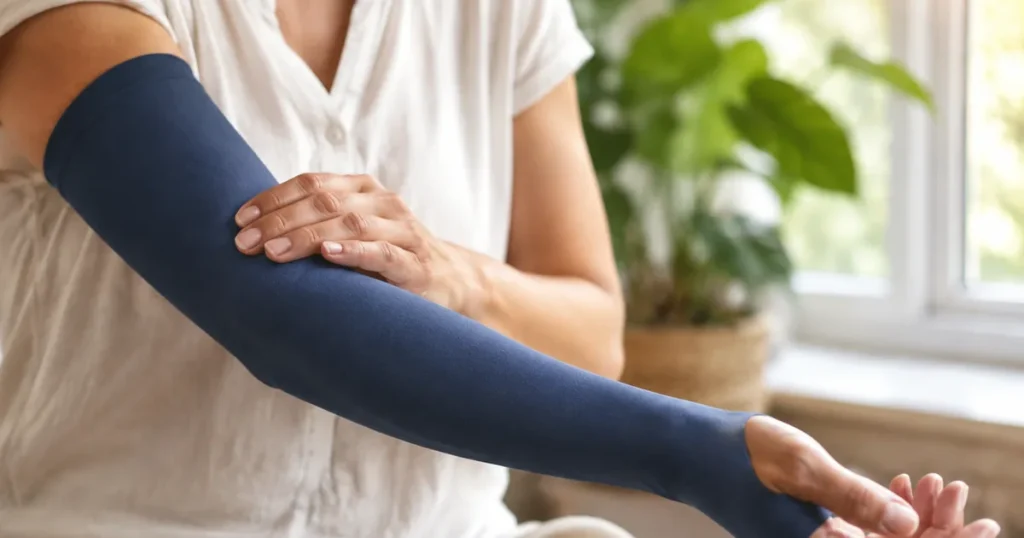
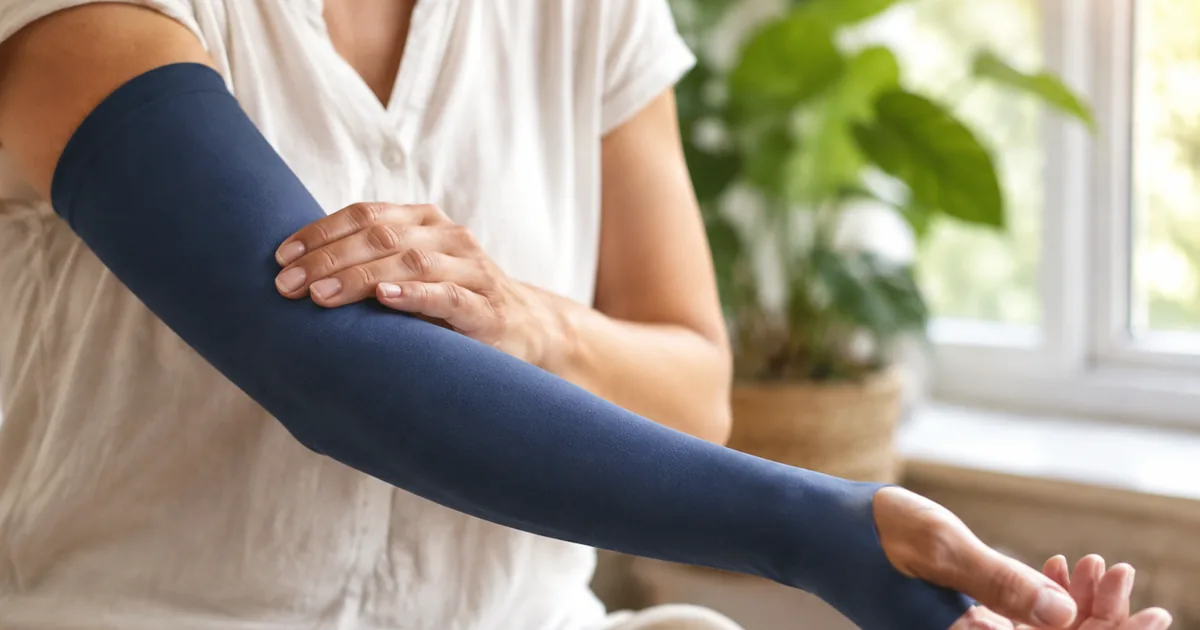
For arm lymphedema after breast cancer treatment, the core garment is a compression sleeve — and if the hand is involved or at risk, a gauntlet or glove is added to help prevent fluid from backing up into the hand. This hand pairing is one of the most commonly missed details in arm lymphedema care.
The pieces work together:
- Sleeve — covers wrist to shoulder (or upper arm). The workhorse of arm lymphedema management.
- Gauntlet — covers the wrist and hand but leaves the fingers free. Often used when swelling or risk is centered on the back of the hand.
- Glove — covers the full hand and fingers, for when the fingers themselves are affected.
A sleeve worn alone can push fluid into the hand — which is why therapists so often pair it with a gauntlet or glove, as Breastcancer.org’s compression sleeve guide explains. Garments are typically 20–30 or 30–40 mmHg for the arm, fitted with precise circumference measurements at the wrist, forearm, and upper arm. You can browse hand and finger pieces in our glove category.
Day Garments vs. Night Garments: Can You Sleep in Compression?
Generally, no — you should not sleep in your daytime compression garments unless your clinician specifically tells you to. Daytime graduated compression garments are designed for vertical, active hours: they work with your muscle pump while you’re upright and moving.
Overnight is different. When you lie down, the force of gravity stops working against lymphatic return, and the elevated resting pressure of an elastic day garment against a still limb can become uncomfortable or even counterproductive. What some patients are prescribed instead:
- Nighttime compression garments — padded, quilted, or adjustable systems (including adjustable wrap-style options and specialized night sleeves) that provide low, resting pressure and gentle tissue support while you sleep
- Self-bandaging at night — short-stretch bandaging applied before bed, common during intensive treatment phases
Both are clinician-directed choices, not defaults. If you’re tempted to wear your daytime sleeve or stocking to bed “to get extra hours,” check with your therapist first — night compression is a different product category for a reason.
When Adjustable Wraps (FarrowWrap-Style) Are the Right Choice
Adjustable compression wraps — like the FarrowWrap line — use overlapping bands with hook-and-loop fasteners so you can set and adjust the pressure yourself, which makes them ideal for fluctuating swelling, donning difficulty, and self-management between therapy visits.
They’re a genuinely different tool from elastic garments:
- Fluctuating volume — if your limb size changes day to day (common in early maintenance or with heat, activity, or salt intake), a wrap adjusts where a fixed-size garment can’t
- Donning difficulty — if arthritis, neuropathy, or grip weakness makes pulling on a tight elastic stocking impossible, wraps fasten around the limb instead
- Transitions — many therapists use wraps as a bridge after intensive decongestive bandaging, before a ready-to-wear or custom garment is ordered
Wraps come in arm, leg, and foot versions, at pressure levels roughly comparable to 20–30 and 30–40 mmHg garments. The AVLS white paper recognizes adjustable compression devices as a standard option within lymphedema compression therapy. See the full range in our FarrowWrap category.
Self-Bandaging vs. Ready-to-Wear: Where Comprilan and Short-Stretch Bandaging Fit
Short-stretch bandaging (typically Comprilan-style low-elasticity bandages) is the workhorse of the intensive phase of CDT, while ready-to-wear garments take over for long-term maintenance. Knowing which phase you’re in clears up most of the confusion, because the two tools do different jobs rather than competing.
Phase 1 — Intensive (decongestive) phase: Your therapist performs MLD daily, then bandages the limb with multiple layers of short-stretch bandage. These bandages have low resting pressure but high working pressure — they resist muscle expansion during movement, creating a strong pump effect. This phase lasts days to several weeks until the limb is decongested.
Phase 2 — Maintenance (optimization) phase: Once the limb has reduced, you’re fitted for a compression garment — circular-knit, flat-knit, or wrap — to hold the result. This is the garment you’ll live in daily, replaced every 3–6 months as elasticity fades.
Both tools matter; they just do different jobs. Explore Comprilan short-stretch bandaging and our ready-to-wear lymphedema garments.
Getting Fitted and Donning Aids
Measure in the morning, when the limb is at its smallest, and never guess a size from your shoe size or clothing size. Garment fit determines whether compression therapy works at all — and poorly fitted high-compression garments can cause skin damage, pain, or restricted arterial flow. Expect your fitter to measure several defined points along the limb.
Your therapist or fitter will measure circumferences at multiple defined points along the limb (for sleeves: wrist, forearm, upper arm; for legs: ankle, calf, knee, thigh — sometimes more). For ready-to-wear, those numbers map to a size chart. For flat-knit custom garments, they’re sent to the manufacturer.
Donning is the other half of compliance. High-compression garments are genuinely hard to put on, and struggling with one every morning is the most common reason people stop wearing them. Options that help:
- Donning gloves — rubberized grip gloves that help you grasp and smooth the fabric
- Donning butlers/aids — frames and sleeves that hold the garment open so you slide your limb in
- Toe caps — worn under stockings to protect toes, smooth toe seams, and even out pressure at the foot
If you’re fighting your garment every day, that’s a solvable problem — browse donning aids and toe caps. For the full measurement walkthrough, see our fit guide, and if you’re still narrowing down which garment type fits your condition, start at shop by condition.
A Note on Safety: Compression Isn’t for Everyone
Graduated compression is not appropriate for everyone. People with peripheral arterial disease (PAD), uncontrolled heart failure, or certain skin or nerve conditions should not use compression without medical clearance — and your clinician should check arterial circulation (often with an ankle-brachial index) before prescribing 20+ mmHg. If you experience numbness, tingling, color change, or increasing pain in a compressed limb, remove the garment and contact your provider.
This content is for educational purposes only and does not replace professional medical advice. Always consult a healthcare provider before starting compression therapy, especially at 20 mmHg or higher or if you have arterial disease, diabetes, or neuropathy. This content has not been reviewed by a licensed healthcare professional.
Frequently Asked Questions
What compression level is best for lymphedema?
Most lymphedema management uses 20–30 or 30–40 mmHg garments, with 40–50 mmHg reserved for severe cases under prescription. The right level depends on your limb’s size, tissue condition, and arterial status — which is why compression at these levels should always be chosen with a certified lymphedema therapist or physician.
Is flat knit or circular knit better for lymphedema?
Flat knit is generally recommended for moderate-to-severe lymphedema because its stiffness contains limb shape changes, while circular knit suits milder swelling and standard-shaped limbs. No head-to-head trials have compared them directly (per a 2019 review, PMID 31305013), so your therapist’s assessment of your limb is the deciding factor.
Can you sleep in compression garments for lymphedema?
Usually no — daytime graduated garments are designed for upright, active hours and can create excessive resting pressure against a still limb overnight. Some patients are instead prescribed special low-pressure nighttime compression or short-stretch bandaging. Only wear compression to bed if your clinician specifically instructs you to, as it’s a different product category.
Do I need a gauntlet or glove with my compression sleeve?
If your hand is swollen or at risk of swelling, yes — wearing a sleeve alone can push fluid into the hand. A gauntlet (fingerless) or glove (full-finger) maintains gradient pressure across the hand and helps prevent this backflow. Your therapist will measure your hand and decide which piece you need based on its current condition.
Are adjustable wraps like FarrowWrap as effective as compression stockings?
They’re different tools rather than direct substitutes. Wraps excel for fluctuating swelling, donning difficulty, and transitions from bandaging; elastic garments provide consistent graduated pressure for stable, maintenance-phase limbs. Many patients use both at different times. Your therapist can tell you which fits your current phase.
How often should lymphedema compression garments be replaced?
Typically every 3 to 6 months with daily wear, because elastic fibers lose effectiveness long before the fabric looks worn. A good sign it’s time: the garment feels noticeably easier to put on than it used to. Many people keep two garments in rotation so one is always available while the other is washed.
Keep Reading
- Compression Level Guide: What the mmHg Numbers Actually Mean
- 15-20 vs 20-30 mmHg Compression Stockings: Which Level Do You Need?
- Shop by Condition
- Find Your Fit: How to Measure for Compression Garments
Find the Right Garment for Your Lymphedema
You don’t have to figure this out alone — and you shouldn’t have to. Start with our shop by condition page to see garments organized by need, or work through our fit guide to get your measurements right before you order. Bring those numbers to your therapist, and you’ll walk out of your next appointment with a garment you’ll actually wear.
JOBST is a trademark of Essity/BSN medical. JobstCompressionStocking.com is an authorized retailer of JOBST products operated by Pro Therapy Supplies; we do not manufacture JOBST products.
This content is for educational purposes only and does not replace professional medical advice. Always consult a healthcare provider before starting compression therapy, especially at 20 mmHg or higher or if you have arterial disease, diabetes, or neuropathy. This content has not been reviewed by a licensed healthcare professional.
Sources
- National Lymphoedema Network — Position Papers: The Diagnosis and Treatment of Lymphedema
- American Vein and Lymphatic Society — Selecting Appropriate Compression for Lymphedema Patients (white paper PDF)
- Reich-Schupke S, Stücker M. Round-knit or flat-knit compression garments for maintenance therapy of lymphedema of the leg? J Dtsch Dermatol Ges. 2019;17(8):775-784. PMID: 31305013
- Breastcancer.org — Compression Sleeves and Garments for Lymphedema