
Compression Stockings for Varicose Veins: Which Level (mmHg) and Style Is Right for You?
By Sean Tang
Published: September 4, 2026 | Last reviewed: September 4, 2026
If you’ve been diagnosed with varicose veins — or you’ve noticed bulging, aching veins after long days on your feet — you’ve probably heard that compression stockings can help. But standing in front of a wall of options, the real questions start: What compression level do I need for varicose veins? Knee-high or thigh-high? And how do I know it fits?
Here’s the short answer: most people with diagnosed varicose veins are recommended 20–30 mmHg (firm, medical-grade) graduated compression, in a knee-high style unless symptoms extend above the knee. Milder early symptoms may only need 15–20 mmHg. Anything 20 mmHg or higher is generally a clinical decision — talk with your healthcare provider before choosing.
This guide walks you through each decision: how compression works, how your vein severity maps to a compression level, which style matches where your symptoms are, and how to measure and wear your stockings correctly.
How Do Compression Stockings Help Varicose Veins?
Compression stockings apply graduated pressure — firmest at the ankle, gradually decreasing up the leg — that is designed to support your veins in moving blood back toward the heart. In varicose veins, the one-way valves inside the veins have weakened, so blood pools and pressure builds, causing the bulging, aching, and swelling you feel.
Graduated compression stockings squeeze most firmly at the ankle and loosen progressively up the calf, which may help support venous return, reduce pooling, and ease swelling and aching from varicose veins. They manage symptoms and may slow progression — they do not cure or eliminate existing varicose veins.
Definition — Graduated compression: A pressure gradient built into a garment, with the highest pressure at the ankle and decreasing toward the top of the garment. This gradient is designed to encourage venous blood flow upward against gravity. Pressure is measured in millimeters of mercury (mmHg), the same unit used for blood pressure.
Clinical guidelines support compression as a first-line conservative measure for chronic venous disease. The UK’s NICE guideline CG168 on varicose veins recommends compression therapy as part of management, and an evidence-based consensus statement on medical compression stockings published on PubMed Central reports symptom improvements — pain, swelling, and leg heaviness — with graduated compression compared with no compression.
One important expectation to set: stockings are a symptom-management tool. Removing a varicose vein requires a procedure (ablation, sclerotherapy, or surgery). Compression may help you feel better day to day and, per some studies, may help slow symptom progression — but it won’t make bulging veins disappear.
How Severe Are Your Varicose Veins? (CEAP in Plain Terms)
Vein specialists grade venous disease using the CEAP classification — a standard system published by Eklöf and colleagues in the Journal of Vascular Surgery (2004) that lets clinicians describe how advanced your condition is. Knowing your “C-stage” makes the compression-level decision much clearer. (For a plain-language overview of the scale, the NCBI StatPearls reference on CEAP is a useful companion.)
CEAP stages varicose veins from C0 (no visible signs) to C6 (an active leg ulcer). Most people shopping for stockings fall between C2 (visible varicose veins) and C4 (skin changes like discoloration). Your stage is the biggest factor in which mmHg level and style your clinician will recommend.
Here’s the scale in everyday language:
| Stage | What it looks like | Typical compression discussion |
|---|---|---|
| C0 | No visible signs | Prevention only; 8–15 or 15–20 mmHg if recommended |
| C1 | Spider veins / reticular veins | 15–20 mmHg commonly suggested |
| C2 | Visible, bulging varicose veins | 20–30 mmHg typical starting point |
| C3 | Swelling (edema) without skin changes | 20–30 mmHg; style depends on where swelling sits |
| C4 | Skin changes — discoloration, thickening, itching | 20–30 or 30–40 mmHg, clinician-directed |
| C5 | Healed leg ulcer | Higher compression, clinician-directed |
| C6 | Active leg ulcer | Medical compression program, clinician-directed |
You don’t need to self-diagnose a stage — but understanding the scale helps you have a more productive conversation with your provider and understand why one person is told “15–20 is fine” while another is prescribed 30–40.
Which Compression Level (mmHg) Do You Need?
This is the question nearly everyone with varicose veins asks first, and the honest answer is: it depends on your stage, your symptoms, and your clinician’s input — especially at 20 mmHg and above.
For early or mild varicose vein symptoms, 15–20 mmHg may be enough. For diagnosed, symptomatic varicose veins, 20–30 mmHg is the typical medical-grade recommendation. Levels of 30–40 mmHg and above are generally reserved for more advanced disease and are a clinical decision made with your provider.
15–20 mmHg (moderate): Often recommended for spider veins and early varicose veins, mild end-of-day swelling, pregnancy-related vein symptoms, and prevention during long periods of standing or travel. Many people find this level comfortable enough for all-day wear with minimal adjustment.
20–30 mmHg (firm, Class 1 medical grade): The most commonly recommended level for diagnosed varicose veins, post-sclerotherapy wear, DVT-risk reduction in at-risk patients, and moderate swelling. This is where compression becomes genuinely medical — and why we (and clinical guidelines) frame 20 mmHg and above as a decision to make with your healthcare provider.
30–40 mmHg (extra firm, Class 2) and 40–50 mmHg (Class 3): Typically used for severe venous insufficiency, significant edema, healed or active ulcers, and lymphedema. These levels should be worn under direct clinical guidance, with properly measured or custom-fit garments.
For a full breakdown of how the levels differ, see our compression level guide and our head-to-head comparison of 15–20 vs 20–30 mmHg stockings.
One research note worth knowing: a randomized trial of 15–20 vs 20–30 mmHg compression for occupational leg edema published on PubMed Central found that both levels reduced swelling — but the 20–30 mmHg group saw greater reduction. More pressure isn’t automatically better for everyone, though; comfort and consistency matter, because a stocking you actually wear daily helps more than a stronger one sitting in a drawer.
Knee-High, Thigh-High, or Pantyhose — Which Style?
Once you know your level, style is actually the easier decision. The rule of thumb is simple: the garment should cover the area where your veins or symptoms are.
If your varicose veins and swelling are below the knee — which is the vast majority of cases — knee-high stockings are usually sufficient and are the easiest style to wear consistently. If you have veins, swelling, or skin changes above the knee, thigh-highs or pantyhose are more appropriate.
Knee-highs are the workhorse of varicose vein management. Most varicose veins appear in the lower leg, knee-highs are cooler, easier to don, less likely to roll or slide, and often less expensive. If your symptoms stop at the knee, start here.
Thigh-highs make sense when varicose veins extend above the knee, when swelling involves the thigh, or when your clinician specifically wants full-leg compression (common after certain vein procedures). The tradeoff is a silicone top band that some people find warm or that can roll if sizing is off.
Pantyhose / waist-high styles are typically chosen when both legs need full coverage, when thigh-highs won’t stay up comfortably, or for aesthetics under dresses and workwear.
A practical tip: for most C2–C3 varicose vein patients, providers start with knee-highs and only move up if symptoms demand it. Comfort drives compliance, and compliance drives results.
Compression Stockings After Sclerotherapy
Sclerotherapy — injections that close off problem veins — is one of the most common varicose vein treatments, and compression afterward is a standard part of aftercare.
After sclerotherapy, most treating clinicians recommend wearing compression stockings, typically 20–30 mmHg, for a period of several weeks — often around 1–3 weeks continuously during the day, then during waking hours longer term. Always follow your own provider’s schedule, since protocols vary by technique and extent of treatment.
Compression after sclerotherapy is thought to help the treated veins stay collapsed, reduce bruising and swelling, and support healing of the injection sites. The exact wear schedule — hours per day, total weeks, and whether you wear them during sleep initially — varies by physician and by how many veins were treated, so your clinician’s instructions take priority over any general guidance.
If you’re stocking up before a procedure, choose the style and level your treating clinic specifies, and make sure you have at least two pairs so one can be washed while the other is worn.
Varicose Veins During Pregnancy
Pregnancy is one of the most common triggers for new varicose veins, thanks to increased blood volume and pressure from the growing uterus on pelvic veins.
Pregnancy-related varicose veins are usually managed with 15–20 mmHg compression, which is commonly considered the appropriate level for most expectant mothers, and support hose or maternity styles for comfort. Always confirm with your prenatal care provider, and seek prompt evaluation for sudden one-sided swelling or pain.
For a dedicated walkthrough of trimester-by-trimester compression choices, see our guide to maternity compression stockings. The good news: pregnancy-related veins often improve within months after delivery, though they may not disappear completely.
How to Measure for Compression Stockings
A compression stocking only works if it fits. Because graduated compression depends on precise garment dimensions, sizing by shoe size or pant size alone often leads to a poor — and ineffective — fit.
Measure your ankle circumference, calf circumference, and calf or leg length — in the morning, before swelling builds — and match those numbers to the brand’s size chart. Compression fit is based on limb measurements, not clothing sizes. A garment that’s too loose under-compresses; too tight in the wrong place can be uncomfortable or unsafe.
The basic measurements:
- Ankle: circumference at the narrowest point above the ankle bone
- Calf: circumference at the widest point
- Length: for knee-highs, from the floor (or a defined point at the foot) to just below the bend of the knee; for thigh-highs, to the gluteal fold
Measure in the morning when your legs are least swollen — later in the day, measurements can run larger and lead to an oversized garment. Our step-by-step fit guide covers the process in detail, including how to measure for thigh-highs and pantyhose.
Putting Stockings On: Donning Tips and Garment Care
Medical-grade stockings are deliberately snug — that’s the point — which also makes them genuinely difficult to put on without technique.
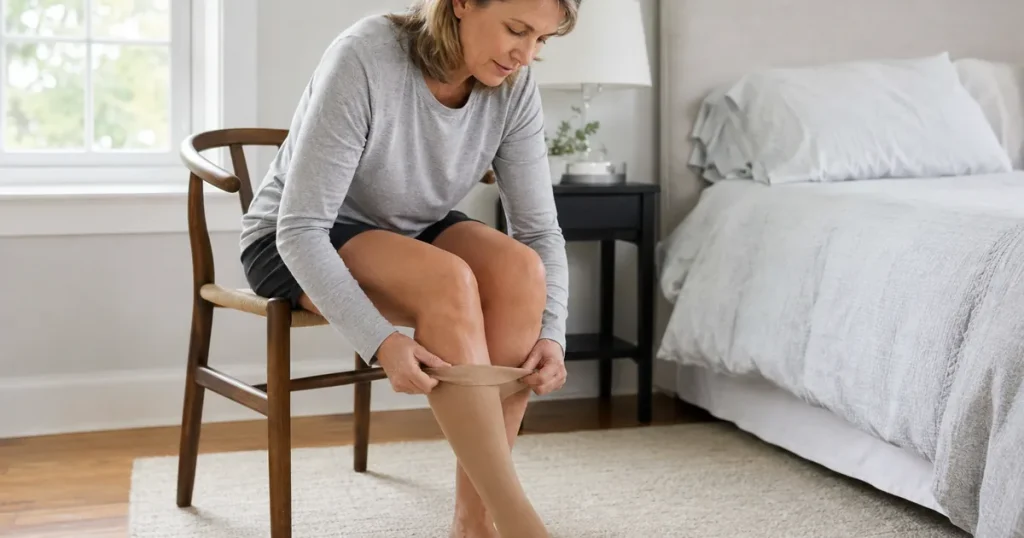
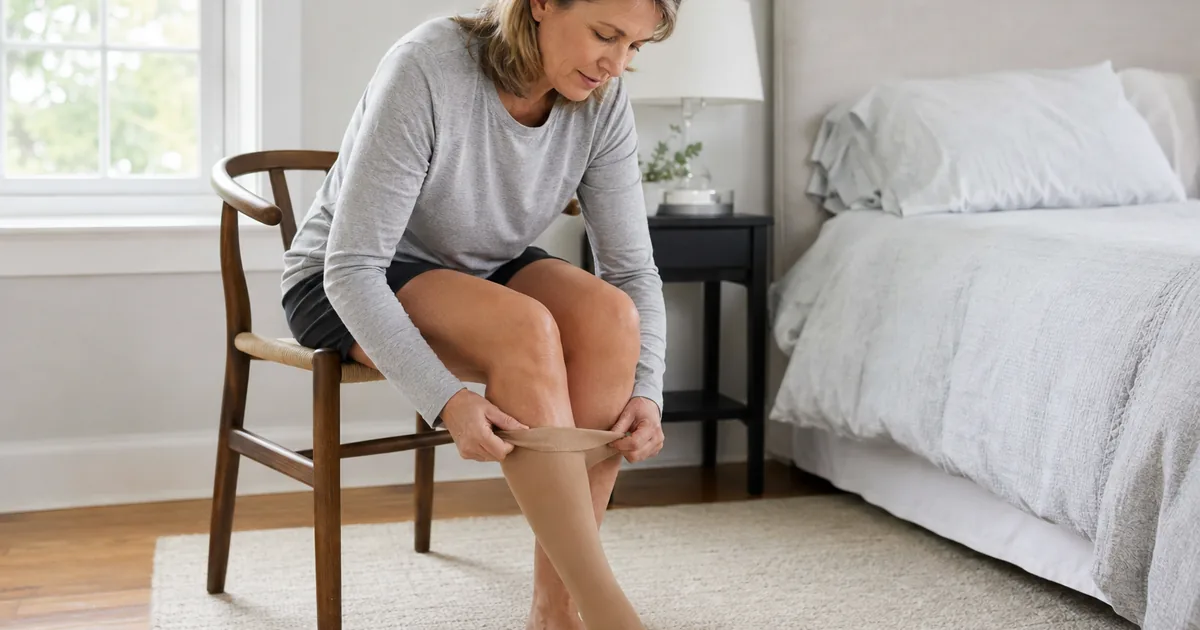
Put compression stockings on in the morning before swelling starts, gather the stocking from the top down to the heel, insert your foot, then smooth the fabric upward without pulling the top band. Donning aids such as gloves or frames can make 20–30 mmHg stockings much easier to manage, especially with arthritis or limited hand strength.
A few habits that extend garment life:
- Wash daily (hand wash or gentle machine cycle in a garment bag) with mild detergent — body oils and sweat break down the elastic fibers
- Air dry; never wring out or tumble-dry compression garments
- Replace every 3–6 months with daily wear, since compression degrades gradually and invisibly — if the stocking feels easy to put on, it’s likely lost much of its pressure
- Avoid lotions right before donning, which makes fabric slippery and fibers degrade faster; apply moisturizer at night instead
If donning is your biggest barrier, browse donning aids and accessories — a small purchase that can make daily compression therapy far more manageable.
Who Should Not Wear Compression Stockings?
Graduated compression is not appropriate for everyone, and this part matters.
People with peripheral arterial disease (PAD), uncontrolled heart failure, severe diabetic neuropathy, or certain skin infections or conditions should not use compression stockings without explicit medical clearance. If you have any of these conditions — or numbness, cold feet, or known circulation problems — talk with your healthcare provider before starting compression therapy.
This is why 20 mmHg and above is treated as a clinical decision throughout this guide: the same pressure that supports venous return can be unsafe when arterial inflow is compromised.
Frequently Asked Questions
What compression level is best for varicose veins?
For diagnosed, symptomatic varicose veins, 20–30 mmHg is the most commonly recommended level. Early or mild symptoms may be managed with 15–20 mmHg. Levels above 30 mmHg are generally a clinical decision made with your healthcare provider.
Can compression stockings get rid of varicose veins?
No. Compression stockings are designed to manage symptoms — aching, swelling, heaviness — and may help slow progression, but they don’t remove existing varicose veins. Procedures like ablation or sclerotherapy are needed to eliminate a vein.
How many hours a day should I wear compression stockings for varicose veins?
Most clinicians recommend wearing them during waking hours, typically 8–12 hours, and removing them for sleep — consistent with MedlinePlus patient guidance. After sclerotherapy, your treating clinician may recommend a more specific schedule, often including several continuous weeks.
Knee-high or thigh-high compression stockings for varicose veins?
If your veins and swelling are below the knee, knee-highs are usually sufficient — and because they’re easier to put on and wear consistently, most people start there. Choose thigh-highs or pantyhose when symptoms extend above the knee or your clinician recommends full-leg compression.
Do I need a prescription for 20–30 mmHg compression stockings?
In the U.S., 20–30 mmHg stockings are available over the counter from authorized retailers like us, so no prescription is needed to purchase them. However, clinical guidance recommends consulting your healthcare provider before wearing 20 mmHg or higher.
How do I know if my compression stockings fit correctly?
They should feel snug and firm but not painful, with no numbness, tingling, or pinching. The heel should sit in place, seams shouldn’t dig in, and you shouldn’t have a tight band at the top edge. If in doubt, re-measure in the morning and check against the size chart.
The Bottom Line
Varicose veins are common, manageable, and worth taking seriously early. For most people with diagnosed varicose veins, that means 20–30 mmHg knee-high stockings, measured carefully, worn during the day, and replaced every few months. Match your compression level and style to your symptoms, loop in your healthcare provider — especially for anything 20 mmHg and above — and build the habit of daily wear.
Ready to find your pair? Shop compression stockings by condition, or start with our step-by-step measuring guide to nail your size before you buy. For the full framework on picking a garment, see how to choose compression stockings.
Keep Reading
- How to Choose Compression Stockings: A Complete Buyer’s Guide
- 15–20 vs 20–30 mmHg Compression Stockings: What’s the Real Difference?
- Shop Compression Stockings by Condition
Disclaimer: This content is for educational purposes only and does not replace professional medical advice. Always consult a healthcare provider before starting compression therapy, especially at 20 mmHg or higher or if you have arterial disease, diabetes, or neuropathy. This content has not been reviewed by a licensed healthcare professional.
JOBST® is a trademark of Essity/BSN medical. JobstCompressionStocking.com is operated by Pro Therapy Supplies, an authorized retailer of JOBST products. We do not manufacture JOBST products.
Sources
- NICE Guideline CG168 — “Varicose veins: diagnosis and management”. National Institute for Health and Care Excellence. — Compression as first-line conservative management.
- Eklöf B, et al. “Revision of the CEAP classification for chronic venous disorders: consensus statement.” Journal of Vascular Surgery. 2004;40(6):1248–1252. — CEAP staging framework.
- Partsch H, et al. “Indications for medical compression stockings in venous and lymphatic disorders: An evidence-based consensus statement.” Phlebology. 2018 (PMC). — Evidence base for graduated compression in chronic venous disease.
- Randomized controlled trial of 15–20 vs 20–30 mmHg compression stockings in occupational leg edema (PMC6188858).
- “Compression stockings.” MedlinePlus Medical Encyclopedia, U.S. National Library of Medicine. — Wear schedule and general patient guidance.
- “CEAP Classification of Venous Disorders.” StatPearls, NCBI Bookshelf. — Plain-language CEAP reference.
Internal Link Inventory (for publisher)
| Anchor | URL | Status (verified 2026-09-04) |
|---|---|---|
| compression level guide | https://www.jobstcompressionstocking.com/compression-level-guide/ | 200 |
| 15–20 vs 20–30 mmHg stockings | https://www.jobstcompressionstocking.com/15-20-vs-20-30-mmhg-compression-stockings/ | 200 |
| maternity compression stockings | https://www.jobstcompressionstocking.com/maternity-compression-stockings/ | 200 |
| fit guide | https://www.jobstcompressionstocking.com/find-your-fit/ | 200 |
| donning aids and accessories | https://www.jobstcompressionstocking.com/product-category/donning/ | 200 |
| shop by condition | https://www.jobstcompressionstocking.com/shop-by-condition/ | 200 |
| how to choose compression stockings | https://www.jobstcompressionstocking.com/how-to-choose-compression-stockings/ | 200 |