
How to Choose Compression Stockings: A Complete Buyer’s Guide
By Sean Tang
Published: August 29, 2026 | Last reviewed: September 1, 2026
Choosing the right compression stocking means picking a compression level in mmHg, a style that matches your symptoms, a fabric that fits your lifestyle, and a size that actually works. This guide walks through each decision step by step. JOBST® is a registered trademark of Essity / BSN medical; Pro Therapy Supplies is an authorized reseller of JOBST products, not the manufacturer.
If you already know you want an off-the-shelf garment, browse our ready-to-wear compression garments to see current JOBST options.
What Are Compression Stockings and How Do They Work?
Compression stockings are elastic garments that apply graduated pressure—strongest at the ankle and lighter up the leg—to help veins push blood back toward the heart, may reduce ankle swelling, and ease leg fatigue during long standing, travel, or recovery. The unit of measurement is millimeters of mercury (mmHg). Edema is fluid buildup under the skin, CVI occurs when vein valves weaken and blood pools, and lymphedema is swelling from a lymphatic issue. Graduated compression may help support circulation, but it does not replace medical evaluation or treatment. A PMC review notes stronger pressure is generally more effective for venous ulcer healing than lower pressure (PMC4081237); another review maps compression classes to venous and lymphatic disease (PMC5846867).
What Compression Level Do I Need?
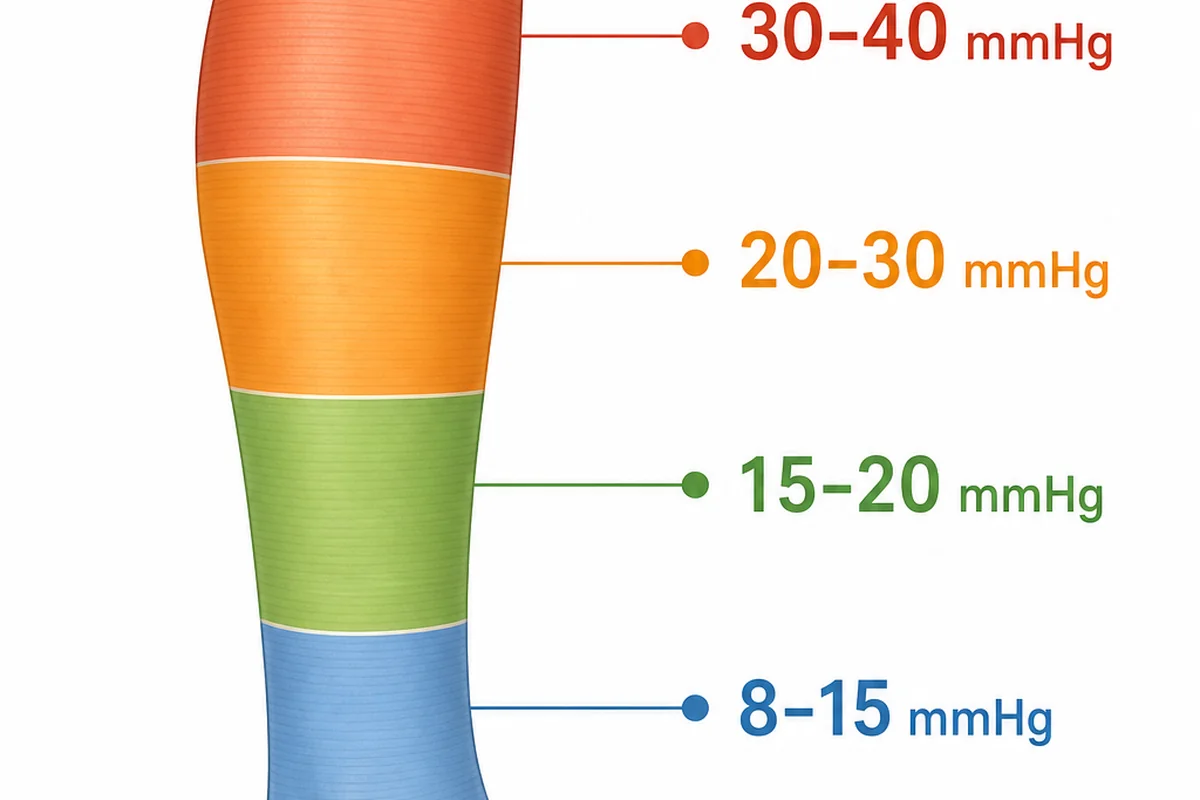
Choose 8–15 mmHg for tired legs and travel, 15–20 mmHg for mild swelling or varicose veins, 20–30 mmHg for moderate vein issues or post-procedure support, and 30–40 mmHg for severe CVI or lymphedema. mmHg measures pressure in millimeters of mercury; lower numbers feel gentler and higher numbers firmer. Outside the U.S., compression classes roughly map as Class I (18–21 mmHg), Class II (23–32 mmHg), and Class III (34–46 mmHg). Always consult a provider before choosing 20 mmHg or higher.
| mmHg Range | Typical Use | Who Should Consider It | Example JOBST Lines |
|---|---|---|---|
| 8–15 | Tired or achy legs, long travel, mild ankle swelling, prevention | People who stand all day, travelers, pregnant people with mild fatigue | Relief, UltraSheer, Sport / ActiveWear |
| 15–20 | Mild varicose veins, minor edema, pregnancy, daily prevention | People with early vein symptoms or occupational leg fatigue | Relief, UltraSheer, Opaque, For Men, Sport |
| 20–30 | Moderate varicose veins, post-sclerotherapy, travel-related DVT risk per provider guidance, moderate edema | Patients with a clinician recommendation for firm support | UltraSheer, Opaque, Relief, For Men, Sport |
| 30–40 | Severe CVI, lymphedema, venous ulcer management | Patients under medical or therapist supervision | Opaque, Relief, Bella Strong, FarrowWrap |
| 40–50 | Severe lymphedema or advanced venous disease | Specialist-managed care with custom fitting | Custom / specialist-managed options; coordinate with a therapist |
If your symptoms are mild, start in the 8–15 or 15–20 mmHg range. If you have a diagnosed vein condition, post-procedure instructions, or significant swelling, a clinician may recommend 20–30 mmHg or higher. PMC notes Class II compression (roughly 23–32 mmHg) is often used for chronic venous disease, while Class III (roughly 34–46 mmHg) is reserved for severe presentations such as venous ulcers or pronounced lymphedema (PMC5846867). MedlinePlus also reminds patients to choose higher compression with provider guidance (MedlinePlus 000597).
What Style or Length Should I Choose?
Knee-high stockings are the most common choice for ankle and calf swelling. Thigh-high or waist-high styles cover more of the leg when swelling or vein issues extend above the knee. Open-toe options help with toe sensitivity or foot ulcers; closed-toe options offer full foot coverage.
| Style | Best For | Coverage Area |
|---|---|---|
| Knee-high | Everyday calf/ankle swelling, travel, occupational standing | Foot to just below the knee |
| Thigh-high | Above-knee varicose veins, post-sclerotherapy thigh treatment, moderate CVI | Foot to upper thigh |
| Waist-high / pantyhose | Pregnancy, severe edema, lymphedema involving the thigh or hip | Foot to waist with abdominal support |
| Open-toe | Toe deformities, foot wounds, warm climates, wearing with sandals | Heel and leg; toes exposed |
| Closed-toe | Full foot compression, warmth, everyday wear | Full foot and leg |
Knee-High vs Thigh-High vs Waist-High
Knee-high stockings are usually the best first choice when symptoms stay below the knee. Thigh-high styles cover above-knee veins and are often used after thigh sclerotherapy. Waist-high pantyhose provide full leg and pelvic coverage and may be more comfortable during pregnancy or when lymphedema extends into the thigh.
Open-Toe vs Closed-Toe Compression Stockings
Open-toe stockings leave the toes free. They may be more comfortable if you have toe deformities, open foot wounds, or toe sensitivity, and they work well in warm climates. Closed-toe stockings give full foot compression and protect the toes, which makes them a common everyday and travel choice.
When Are Arm Sleeves or Gauntlets Used?
Arm sleeves and gauntlets are used for upper-extremity lymphedema, including breast-cancer-related arm swelling. A sleeve extends from the wrist to the upper arm; a gauntlet covers the hand and may be worn with a sleeve to control hand edema. Explore ready-to-wear compression garments, toe caps, and gloves/gauntlets for these needs.
Which Fabric or Product Line Is Right for My Lifestyle?
Pick sheer fabrics like JOBST UltraSheer for dress or professional wear, opaque fabrics for more coverage and durability, Relief for everyday value, Sport or ActiveWear for athletic recovery or travel, and For Men for dress and casual styles. Choose the fabric that matches your daily activity and how often you will wear the garment.
JOBST product-line names are trademarks of Essity / BSN medical. Pro Therapy Supplies carries these lines as an authorized reseller and does not manufacture them. The recommendations below are educational illustrations, not prescriptions.
JOBST UltraSheer
UltraSheer is a lightweight, sheer hosiery line for women who want compression that looks like traditional dress hosiery, available from 8–15 mmHg up to 30–40 mmHg. Browse the JOBST UltraSheer line for current styles.
JOBST Relief
Relief is a value-focused line with reinforced heel and toe areas, designed for everyday wear and easy care from 8–15 mmHg through 30–40 mmHg. See the JOBST Relief compression stockings category.
JOBST Opaque
Opaque offers a matte, opaque finish with soft, durable fabric from 15–20 mmHg through 30–40 mmHg. The fuller coverage may be more comfortable in cooler weather. View the JOBST Opaque compression stockings collection.
JOBST For Men
For Men includes dress, casual, and ribbed styles made to look like ordinary men’s socks, commonly in 15–20 mmHg and 20–30 mmHg. Explore the JOBST For Men category.
JOBST Sport / ActiveWear
Sport and ActiveWear are lower-profile performance socks for athletes, travelers, and long-shift workers, focusing on recovery and comfort during movement. Check the JOBST Sport and ActiveWear categories.
FarrowWrap vs Traditional Stockings
FarrowWrap is an adjustable Velcro-style wrap system used for lymphedema or chronic venous edema when stockings are hard to put on or take off. The wrap can be loosened or tightened as swelling changes, while traditional stockings provide consistent graduated compression when fit is correct. For many patients, the best garment is the one they will use every day. Learn more about FarrowWrap adjustable wraps.
How Do I Get the Right Fit?
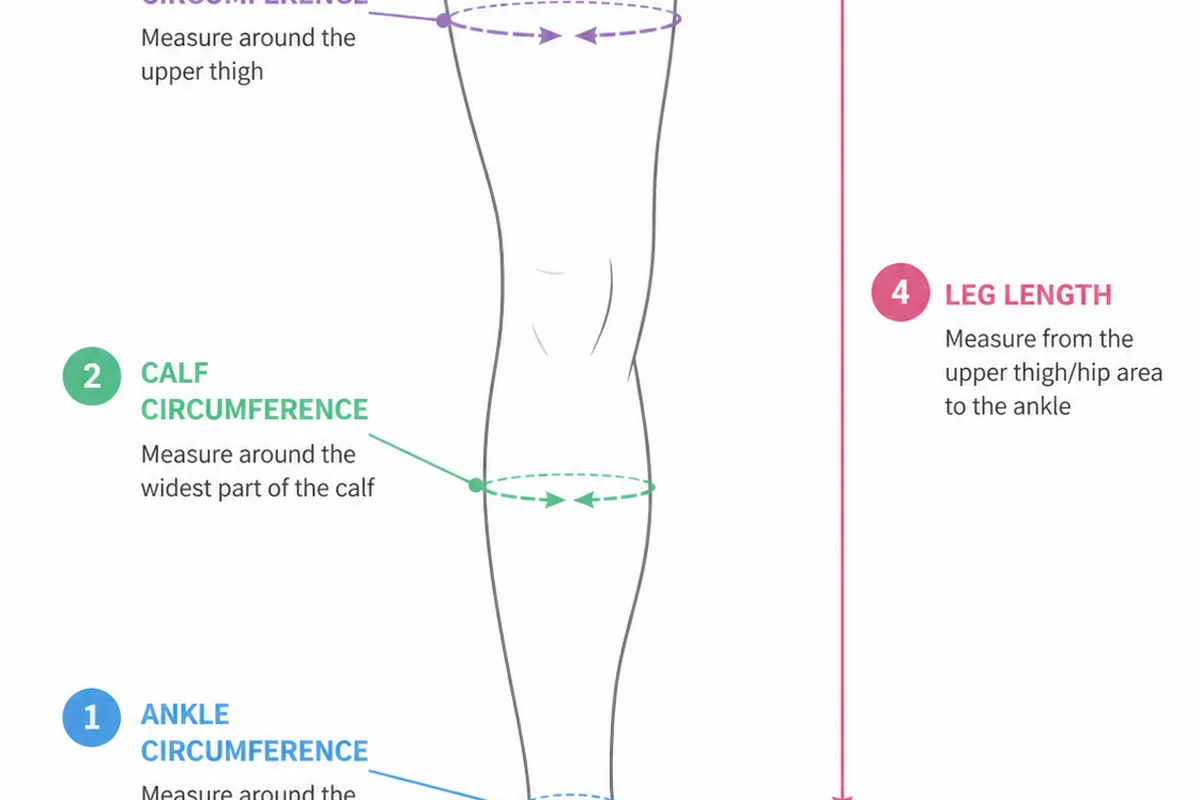
Measure your ankle, calf, and thigh circumference in the morning before swelling builds, then compare your measurements to the manufacturer’s sizing chart. A well-fitted stocking should feel snug, not painful, with no bunching or rolling. Fit matters as much as pressure—an ill-fitting 20–30 mmHg garment may be less effective than a fitted 15–20 mmHg garment.
Step-by-Step Measuring Guide
- Measure ankle circumference at the narrowest point above the bone.
- Measure calf circumference at the widest point.
- Measure thigh circumference at the widest point if choosing thigh-high or waist-high.
- Measure leg length from floor to bend of knee for knee-high, or floor to gluteal fold for thigh-high.
- Take measurements in the morning before activity, when swelling is usually lowest.
What If My Measurements Fall Between Sizes?
If your measurements fall between sizes, follow the manufacturer guidance for the specific style. Do not size up just to make donning easier, because the pressure will be incorrect. A certified fitter or healthcare provider can help you decide whether a different style or compression level is a better match.
What If I Can’t Put the Stockings On?
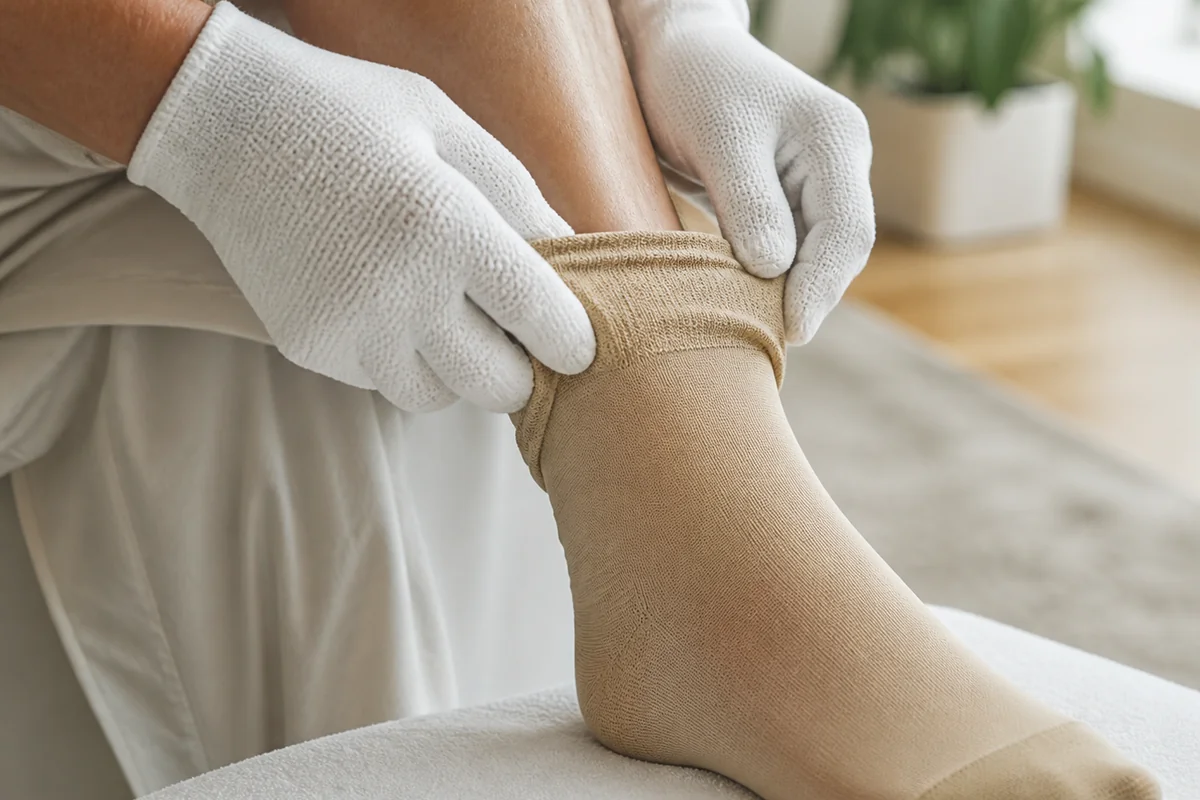
Use a stocking donner, donning gloves, or a butler frame to reduce the struggle of pulling on higher-mmHg garments. These accessories grip the fabric, protect the stocking from tears, and reduce hand strain. If donning remains impossible, an adjustable wrap system such as FarrowWrap may be a practical alternative.
Donning means putting on a compression garment. Higher compression fabrics are less elastic, so they can be difficult to stretch over the foot and ankle. Donning aids increase leverage and protect the stocking from snags that create runs or weak points.
Types of Donning Aids
- Donning gloves have textured palms that grip the fabric so you can smooth the stocking up the leg without tearing it.
- Stocking donners / butlers are metal or plastic frames that hold the stocking open while you slide your foot in.
- Foot slippers reduce friction when sliding the foot through the initial opening.
If hand weakness, arthritis, or very firm 30–40 mmHg fabric makes donning impossible, do not abandon compression therapy. Talk with your provider about compression stocking donning aids, patient accessories, or a FarrowWrap system.
When Should I Talk to a Healthcare Provider?
Consult a provider before choosing 20 mmHg or higher, if you have peripheral arterial disease, uncontrolled heart failure, diabetes with neuropathy, active skin infections, or cold/pale feet. A clinician or certified fitter can confirm the right compression level, style, and size for your condition and insurance requirements.
Contraindications and Red Flags
Graduated compression is not appropriate for everyone. People with peripheral arterial disease (PAD), uncontrolled heart failure, severe cardiac disease, active leg ulcers with uncontrolled infection, severe neuropathy, or an allergy to stocking materials should seek medical clearance before wearing compression garments. If your feet are cold, pale, blue, or numb, remove the stockings and contact a clinician.
Higher Compression and Insurance
Compression of 20 mmHg and above is often documented as a medical recommendation. Some insurers require a prescription or Letter of Medical Necessity before covering the cost. Keep your provider notes and receipts for reimbursement. Coverage rules vary by plan, so contact your insurer before ordering. The Mayo Clinic News Network notes that compression stockings are often recommended after a medical evaluation and that fit guidance from a clinician can improve comfort.
How Do I Care for Compression Stockings So They Last?
Hand wash or machine wash on gentle in lukewarm water, then air dry. Avoid bleach, fabric softener, and high heat, which break down elastic fibers. Daily washing removes skin oils and perspiration; if you wear compression every day, consider buying two pairs so each can rest between uses. Replace stockings every 3–6 months when they lose elasticity and pressure (MedlinePlus 000597).
Frequently Asked Questions
What is the difference between 15-20 and 20-30 mmHg compression stockings?
15–20 mmHg provides gentle to moderate support for mild swelling, minor varicose veins, pregnancy, and travel. 20–30 mmHg offers firmer support for moderate vein issues, post-sclerotherapy, and clinician-guided DVT risk management. Twenty mmHg and above is generally a clinical decision—ask your provider before choosing this level.
How do I measure for JOBST compression stockings?
Measure ankle, calf, and thigh circumferences, plus leg length, in the morning before swelling builds. Compare your numbers to the JOBST sizing chart for the specific style. If measurements fall between sizes or you have swelling that changes during the day, consult a certified fitter or healthcare provider.
Can compression stockings help with varicose veins?
Compression stockings may help reduce aching, heaviness, and swelling associated with varicose veins by supporting venous return. They do not cure varicose veins. Clinical guidelines suggest graduated compression as a conservative management option; discuss the right mmHg level and style with your provider.
Should I choose open toe or closed toe compression stockings?
Choose open-toe stockings if you have toe sensitivity, foot wounds, or prefer to wear your own socks. Choose closed-toe stockings for full foot compression, warmth, and everyday wear. Open-toe pairs work well with sandals, while closed-toe pairs feel better in cooler weather. Both styles can deliver the same graduated compression if fitted correctly.
What donning aid should I use for 30-40 mmHg stockings?
For 30–40 mmHg stockings, use donning gloves and a stocking donner or butler frame. The gloves grip the fabric, while the donner holds the stocking open so you can slide your foot in with less effort. These tools also protect the garment from tears.
How tight should compression stockings feel?
They should feel snug and supportive but not painful. You should be able to slide a finger under the fabric at the top band. Red marks, numbness, tingling, or color changes mean the fit or compression level may be wrong—remove the stocking and consult your provider.
Are JOBST compression stockings covered by insurance?
Some insurers cover compression stockings when prescribed by a provider, especially at 20 mmHg or above. Coverage varies by plan and may require a prescription, diagnosis, and supplier documentation. A Letter of Medical Necessity from your clinician and an itemized receipt from an authorized supplier can strengthen your claim. Contact your insurer before ordering.
How long do compression stockings last?
Most compression stockings last 3–6 months with daily wear. Elastic fibers degrade with washing and stretching, causing the garment to lose its designed pressure. Rotating two pairs and air drying can extend their useful life. Replace stockings when they feel loose, sag, or no longer provide the same support.
Product Recommendations
For daily value and easy care, explore JOBST Relief compression stockings. For sheer dress hosiery, see the JOBST UltraSheer line. If you want fuller coverage and durability, the JOBST Opaque compression stockings collection is a strong option. Men can browse JOBST For Men, and active users can check JOBST Sport or ActiveWear. For lymphedema or difficulty donning, look at FarrowWrap adjustable wraps and compression stocking donning aids. If you are unsure where to start, the ready-to-wear compression garments category gathers the broadest JOBST selection.
Related Articles
Future guides will cover measuring for compression stockings, comparing 15–20 mmHg and 20–30 mmHg garments, choosing compression stockings for travel, and how to put on compression stockings with donning aids.
About Pro Therapy Supplies
Pro Therapy Supplies is an authorized reseller of JOBST® compression garments and therapy products. We are not the manufacturer. JOBST® and product-line names such as UltraSheer, Relief, Opaque, and FarrowWrap are trademarks of Essity / BSN medical. Our editorial team focuses on practical, evidence-based guidance to help patients and caregivers choose compression garments, use them correctly, and get the most from therapy.
Sources
- NIH/PMC, “Graduated compression stockings,” PMC4081237
- NIH/PMC, “Indications for medical compression stockings in venous and lymphatic disease,” PMC5846867
- MedlinePlus, “Compression stockings,” 000597
- Mayo Clinic News Network, “Tips for Using Compression Stockings,” newsnetwork.mayoclinic.org
- NIH/PMC, “Compression sleeve in mild breast cancer-related arm lymphedema,” PMC10216311
Medical Disclaimer
This content is for educational purposes only and is not a substitute for professional medical advice, diagnosis, or treatment. Always consult a healthcare provider before starting compression therapy, especially if you are considering 20 mmHg or higher, or if you have peripheral arterial disease, uncontrolled heart failure, diabetes with neuropathy, or active skin infections. Compression therapy is not appropriate for everyone. If you experience pain, numbness, tingling, color changes, or cold feet while wearing compression garments, remove them and seek medical advice.

Written by Sean Tang
Founder of Pro Therapy Supplies and JOBST Compression Stocking. Medicare-enrolled DME supplier with 20+ years experience helping patients navigate insurance coverage for compression therapy and home medical equipment.