
Does Medicare Cover Compression Stockings? (2026 Guide)
If you’ve just been quoted $60 or more for a pair of compression stockings, the first question on your mind is probably whether Medicare will help pay. You’re not alone — “does Medicare cover compression stockings” is one of the most-searched insurance questions we hear from customers, and the honest answer surprises most people.
In this guide, we’ll walk you through the two narrow pathways where Medicare may cover compression stockings, what you’ll pay in 2026 if you qualify, exactly how to get coverage approved step by step, and what to do if your claim is denied. We’ll also tell you plainly what Medicare won’t pay for, so you can plan accordingly.
Original Medicare covers compression stockings only through two narrow pathways: (1) as surgical dressings for a treated open venous stasis ulcer (HCPCS A6531/A6532/A6545), and (2) since January 1, 2024, as lymphedema compression treatment items under the Lymphedema Treatment Act for patients with a qualifying lymphedema diagnosis. Mild 8–15 or 15–20 mmHg stockings, travel socks, and stockings for varicose veins or chronic venous insufficiency alone are not covered. When covered, you pay 20% of the Medicare-approved amount after the Part B deductible ($283 in 2026) if your supplier accepts assignment.
What Medicare Covers vs. Doesn’t Cover at a Glance
Short answer: usually no — but two specific situations qualify. Before we get into the details, here’s the side-by-side view so you can find your situation fast.
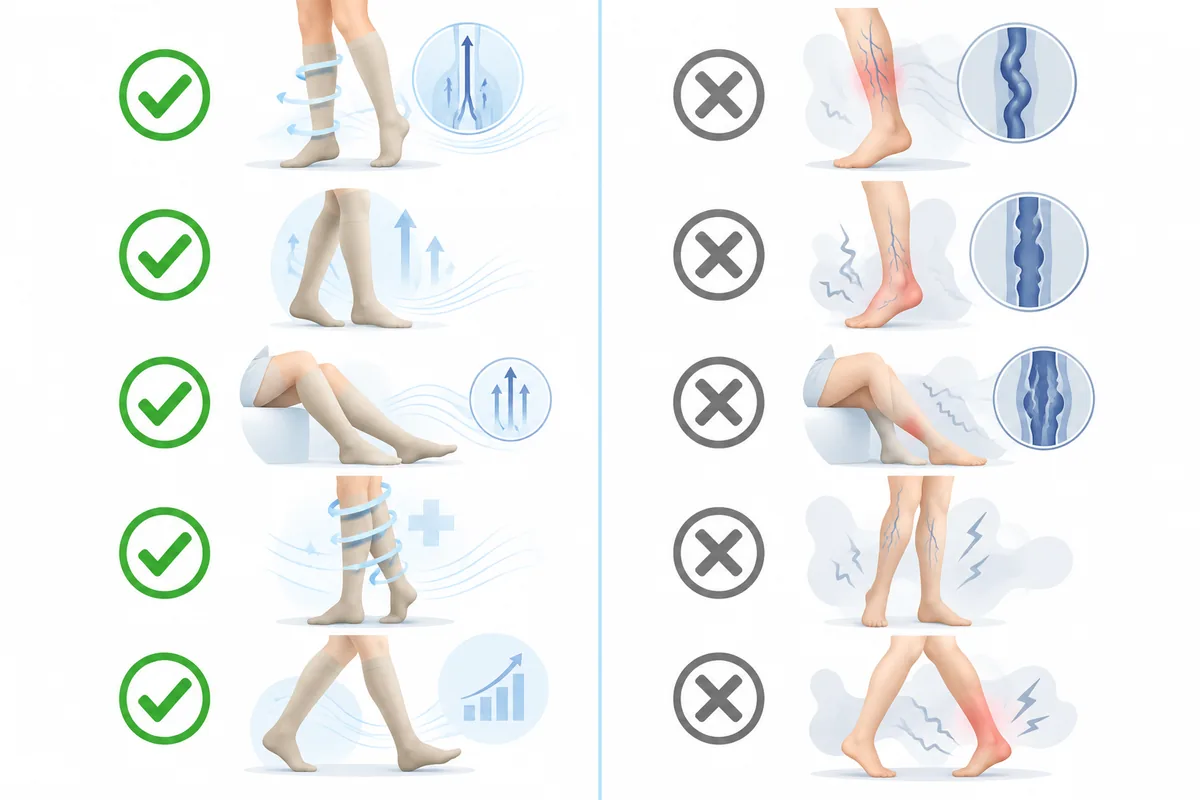
| Situation | Covered? | Pathway / Why | Typical Out-of-Pocket |
|---|---|---|---|
| Open venous stasis ulcer under active treatment | Yes — may be covered | Pathway A: Surgical dressing benefit (HCPCS A6531/A6532/A6545) | 20% coinsurance after the Part B deductible, if your supplier accepts assignment |
| Qualifying lymphedema diagnosis with physician/PA/NP order | Yes — may be covered | Pathway B: Lymphedema Treatment Act benefit (since Jan 1, 2024) | 20% coinsurance after the Part B deductible, if your supplier accepts assignment |
| Varicose veins or chronic venous insufficiency without an open ulcer | No | No qualifying benefit category — claims typically deny | Full self-pay |
| Travel, athletic recovery, pregnancy, prevention, or standing-all-day use | No | Not a Medicare benefit category | Full self-pay |
| Retail OTC purchase without an order, from a non-enrolled supplier | No | Medicare requires an order and a Medicare-enrolled DMEPOS supplier | Full self-pay |
At Jobst Compression Stocking, we’re a Medicare-enrolled DMEPOS supplier (NPI 1497995971), so we navigate these rules with patients every day. What follows is exactly how coverage works.
When Does Medicare Cover Compression Stockings?
Yes — but only in two situations: (1) as a surgical dressing for an open venous stasis ulcer under active treatment (HCPCS A6531/A6532/A6545), and (2) as lymphedema compression treatment items under the Lymphedema Treatment Act, with a qualifying lymphedema diagnosis and physician/PA/NP order. Almost every other reason — varicose veins alone, travel, mild swelling — falls outside the benefit.
Here are the two pathways in detail.
Pathway 1 — Surgical Dressing Benefit (Open Venous Stasis Ulcer)
Under Medicare’s surgical dressing benefit, gradient compression stockings may be covered only when used as a surgical dressing for an open venous stasis ulcer that is being actively treated. The payable HCPCS codes are:
- A6531 — gradient compression stocking, 30–40 mmHg, below-knee (the standard payable item)
- A6532 — gradient compression stocking, 40–50 mmHg, below-knee
- A6545 — gradient compression wrap, non-elastic
Coverage is limited to the limb with the ulcer, and typically to one garment per affected limb. The knee-high, ready-to-wear 30–40 mmHg A6531 is the item most often approved. The policy basis is CMS LCD L33831 (Surgical Dressings), and the code descriptors were updated per CMS transmittal R12471CP to make the “used as a surgical dressing” requirement explicit.
One critical point: varicose veins or chronic venous insufficiency alone — without an open ulcer — do not qualify. Claims submitted without ulcer documentation under this pathway typically deny.
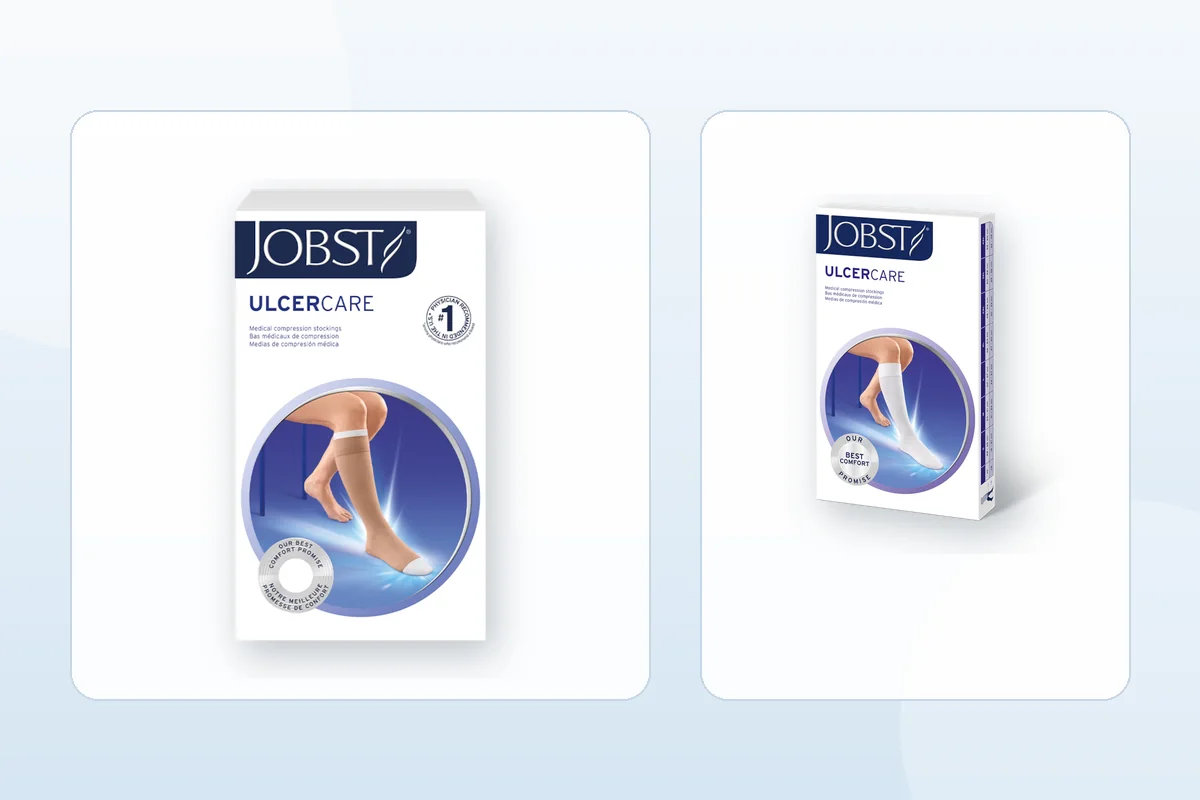
If this pathway applies to you, the garment type Medicare actually pays for is a 30–40 mmHg knee-high. That’s exactly the style of our JOBST UlcerCare zippered compression system — the 30–40 mmHg knee-high style billed under A6531, which pairs a zippered compression stocking with liner socks for ulcer treatment.
Pathway 2 — Lymphedema Compression Treatment Items (since Jan 1, 2024)
The Lymphedema Treatment Act created a statutory Medicare DMEPOS benefit — codified at SSA §1861(s)(2)(JJ) and 42 CFR 410.36(a)(4) — covering standard and custom-fitted gradient compression garments (daytime and nighttime), plus bandaging supplies and accessories, for each affected body part when medically necessary for lymphedema. CMS implemented the benefit under MM13286, with full details on the CMS lymphedema compression treatment items page.
Key requirements and quantity limits, per the final rule (lymphedematreatmentact.org):
- A physician, PA, or NP order is required — a lymphedema diagnosis alone is not enough, and compression ordered for other conditions is not covered under this benefit.
- Daytime garments: up to 3 per affected body part every 6 months.
- Nighttime garments: 1 per affected body part every 2 years.
- Bandaging supplies and accessories: no fixed limit; reviewed case by case.
One related exclusion: compression bandage application is not covered, because Medicare considers it an unskilled service (CMS A52959).
If you have a qualifying lymphedema diagnosis, you can browse our compression collection for daytime and nighttime gradient garments.
How the Lymphedema Treatment Act Changed Coverage
Before January 1, 2024, Medicare had no statutory benefit for compression garments at all — patients with lymphedema largely paid out of pocket, even with a clear medical need. The Lymphedema Treatment Act changed that by defining compression treatment items as a covered DMEPOS benefit with its own fee schedule and written quantity limits. In practical terms, lymphedema patients now have the same kind of defined, billable benefit that ulcer patients had under the surgical dressing policy — but with documented order requirements and per-body-part limits that didn’t exist before.
What Compression Stockings Does Medicare NOT Cover?
Medicare does not cover mild compression stockings (8–15 or 15–20 mmHg) without a qualifying diagnosis, travel compression socks, athletic recovery sleeves, occupational or pregnancy-related compression, or stockings for varicose veins or chronic venous insufficiency without an open ulcer. Retail OTC purchases without an order — or from a supplier that isn’t Medicare-enrolled — are also excluded.
The full list:
- Mild compression stockings (8–15 or 15–20 mmHg) without a qualifying covered diagnosis
- Travel compression socks — flying, driving, long trips
- Athletic recovery stockings and sleeves
- Occupational use — standing all day, working on your feet
- Pregnancy-related compression stockings
- Varicose veins or chronic venous insufficiency without an open venous ulcer — claims under the surgical dressing pathway will deny
- Retail OTC purchases without an order, or from a supplier that isn’t Medicare-enrolled
If you landed on this article for one of these reasons, you’re not alone — the majority of compression stocking buyers are self-pay. The good news: self-pay compression stockings are widely available at every mmHg level, and cost far less than most people expect.
How Much Will I Pay for Covered Compression Stockings?
When compression stockings qualify under either pathway, standard Part B cost-sharing applies. After you meet the annual Part B deductible — $283 as of 2026 — Medicare pays 80% of the Medicare-approved amount, and you pay the remaining 20% as coinsurance. For lymphedema compression treatment items, the approved amount is based on the lesser of the supplier’s actual charge or the DMEPOS fee schedule national payment amount; the same Part B cost-sharing logic applies to the surgical-dressing pathway. You can verify the general rules on the Medicare.gov DME coverage page.
Two things to confirm before you order:
- Assignment. Your supplier must accept assignment (participate in Medicare). If not, you may be charged more than the 20% coinsurance. Always confirm before ordering.
- The exact approved amount. It varies by item and is set by the Medicare fee schedule — your supplier can confirm the figure for your specific garment before you order.
We’re a Medicare-enrolled DMEPOS supplier (NPI 1497995971) with CMS accreditation, and we’ll tell you before you order whether your item is likely covered and exactly what you’d owe. Check your insurance coverage before you order — it takes minutes and can save you a surprise bill.
Does Medicare Advantage Cover Compression Stockings?
Medicare Advantage (Part C) plans must cover at least Original Medicare benefits, so the same two pathways described above apply. However, MA plans operate their own networks, prior-authorization rules, and copay structures — and some plans offer enhanced or over-the-counter benefits that go beyond Medicare minimums, including compression garments for members who wouldn’t qualify under Original Medicare. Coverage details vary widely by plan, so always verify with your specific plan before ordering.
How to Get Medicare to Cover Your Compression Stockings (Step-by-Step)
Follow these six steps in order. Most coverage failures trace back to skipping one.
- Get the right diagnosis. You need an open venous stasis ulcer (ICD-10 I83.x or L97.x) or a qualifying lymphedema diagnosis (I89.0). Without one of these, compression stockings aren’t a covered benefit regardless of mmHg level.
- Get the order. Your treating physician, PA, or NP must write an order for the garments — a Certificate of Medical Necessity or written order prior to delivery, where required. The order must document medical necessity for the covered diagnosis.
- Choose a Medicare-enrolled DMEPOS supplier. The supplier needs an NPI, CMS accreditation under the DMEPOS Quality Standards, and a surety bond. Confirm in writing that they accept assignment.
- Sign an Advance Beneficiary Notice (ABN) if the item may be non-covered. An ABN tells you in advance what you’d owe if Medicare denies the claim — never accept a “possibly covered” item without one.
- The supplier submits the claim to the DME MAC with the HCPCS code, your ICD-10 diagnosis code, and medical-necessity documentation on file. Our complete guide to billing compression garments through insurance walks through the paperwork in detail.
- You pay your share. After the deductible, you pay the 20% coinsurance and the supplier bills Medicare for the remaining 80%.

What If Medicare Denies My Claim?
A denial isn’t necessarily the end. If you signed an ABN, it spelled out your potential liability up front, and you can still pursue an appeal — the first step is a redetermination request through the supplier or your DME MAC, followed by reconsideration if needed. The most common denial reasons are missing ulcer documentation, an incorrect or mismatched HCPCS code, or a supplier that isn’t Medicare-enrolled — all fixable on a resubmission.
If coverage genuinely doesn’t apply, many patients buy 30–40 mmHg ulcer-care garments out of pocket while pursuing coverage — often more affordable than expected, and you don’t wait on a claim to start treatment. You can shop the JOBST UlcerCare Compression System or ask us about your coverage in the meantime.
Frequently Asked Questions
Does Medicare cover compression stockings in 2026?
Only in two situations: as a surgical dressing for a treated open venous stasis ulcer (HCPCS A6531/A6532/A6545), or as lymphedema compression treatment items under the Lymphedema Treatment Act. Otherwise, no. When covered, you pay 20% after the $283 Part B deductible with an assignment-accepting supplier.
Does Medicare pay for compression stockings for lymphedema?
Yes, since January 1, 2024, for patients with a qualifying lymphedema diagnosis and a physician/PA/NP order. Daytime garments are limited to 3 per affected body part every 6 months; nighttime garments, 1 per body part every 2 years. You pay 20% coinsurance after the Part B deductible.
What compression stockings does Medicare cover (mmHg levels)?
Under the surgical-dressing pathway, Medicare covers gradient compression of 30–40 mmHg (A6531) or 40–50 mmHg (A6532) below-knee garments and gradient compression wraps (A6545) — only for an open venous stasis ulcer. Mild 8–15 or 15–20 mmHg stockings are not covered.
How many pairs of compression stockings will Medicare pay for per year?
For ulcer care, typically one garment per affected limb. For lymphedema, the limit is 3 daytime garments per affected body part every 6 months and 1 nighttime garment per body part every 2 years. Bandaging supplies have no fixed limit and are reviewed case-by-case.
How much does Medicare pay for compression stockings?
After you meet the annual Part B deductible ($283 as of 2026), Medicare pays 80% of the Medicare-approved amount and you pay the remaining 20% as coinsurance. The approved amount varies by item and is set by the Medicare fee schedule — your supplier can confirm the exact figure before you order.
Does Medicare Advantage cover compression stockings?
MA plans must cover at least Original Medicare benefits, so the same two pathways apply, but networks, prior-authorization rules, and copays vary by plan. Some MA plans add enhanced or OTC benefits that cover compression garments beyond Medicare minimums. Verify with your specific plan.
Do I need a prescription for Medicare to cover compression stockings?
Yes. A physician, PA, or NP must order the garments, and the order must document medical necessity for a covered diagnosis (open venous ulcer or qualifying lymphedema). A diagnosis alone isn’t enough, and retail OTC purchases without an order aren’t covered.
Will Medicare cover compression stockings for varicose veins or travel?
No. Varicose veins or chronic venous insufficiency without an open venous stasis ulcer are non-covered, and claims will deny. Compression socks for travel, athletic recovery, pregnancy, or prevention are also excluded from Medicare coverage.
The Bottom Line
Medicare covers compression stockings through exactly two doors: the surgical dressing pathway for an open venous stasis ulcer, and the Lymphedema Treatment Act benefit for a qualifying lymphedema diagnosis. When covered, expect the annual Part B deductible ($283 as of 2026) plus 20% coinsurance of the Medicare-approved amount with a supplier who accepts assignment. Everything else — travel socks, mild support, varicose veins without an ulcer — is self-pay.
Not Sure If Your Compression Stockings Are Covered?
The rules are narrow, but if you have an open venous ulcer or a lymphedema diagnosis, Medicare may cover your compression garments — and we’ll help you find out. As a Medicare-enrolled DMEPOS supplier (NPI 1497995971), we can verify your coverage before you order.
- Check your insurance coverage →
- Shop the JOBST UlcerCare Compression System → — 30–40 mmHg zippered knee-highs with liners, the A6531-class style used in ulcer treatment
- Read our complete insurance billing guide →
This content is for educational and informational purposes only. It is not a substitute for professional medical advice, diagnosis, or treatment. Coverage rules change; verify details with Medicare.gov and your healthcare provider. Medicare enrollment and coverage decisions rest with CMS and your plan.
Related Articles
- How to Bill Compression Garments Through Insurance: The Complete Guide — our flagship walkthrough of DME paperwork, orders, and claims
- 15-20 mmHg vs 20-30 mmHg Compression Stockings: Which Level Do You Need? — choosing the right compression level
- How to Measure for Compression Stockings — get the right fit the first time
Author: Sean Tang, Owner, Jobst Compression Stocking